

A conversation with Dr. Boss, Nawamin Pinpathomrat, about old recipes, new dishes, and his dream of taking our hometown fried chicken far beyond the neighborhood.
Imagine a day when people overseas crave fried chicken and “Hat Yai” is one of the names that comes to mind, even if they have never been to Songkhla.
For Dr. Boss, Nawamin Pinpathomrat, this is a vision he hopes to make real. Its beginnings are close to home: in the recipes we know, in local kitchens, and in a question worth exploring – how far can our food travel if we give it the chance to take on a new look?
This conversation explores old recipes that deserve more than a place on a shelf, the many ways authenticity can be understood, and Dr. Boss’s ambition to make Hat Yai fried chicken a name recognized around the world.
When old recipes meet a new generation, does one side have to give way?
We begin with a question for anyone who cooks: if younger people say old recipes no longer belong in new dishes because they do not suit modern tastes, how would Dr. Boss respond?
He takes us back to the origins of each dish. Even the food we call new is rooted in something that came before, including recipes, techniques, and ways of thinking passed down over time. The next step is to develop those foundations for the present day and make them easier for more people to enjoy.
There is still plenty of work for old recipes to do. Their appearance or presentation may change, or they may be expressed through dishes that feel more familiar to a younger generation, with inherited knowledge providing the foundation for what comes next.
This idea also shaped Dr. Boss’s approach to opening his restaurant. He wants to elevate local food while making it accessible to people of every age and background. Each dish presents an enjoyable challenge: how can someone who grew up with these flavors and someone tasting them for the first time sit at the same table and enjoy the experience together?
When food changes its appearance, the question “Is it authentic?” soon follows
Chefs who reinterpret local food will know these questions well. Can it still be called the same dish? After so many changes, is it still authentic?
Dr. Boss believes there is room for interpretation. Every restaurant has something different to present. Some aim to pass on familiar flavors, while others invite diners to encounter something new.
What matters is the story a restaurant is telling and how it develops the original roots of a dish. When food reaches a new audience, it naturally creates a new conversation. Sometimes the questions around the table can be just as enjoyable as the food on the plate.
Returning home to more open-minded diners
After competing on the culinary stage and returning to his hometown, Dr. Boss noticed that people still held on to familiar eating habits. At the same time, interest in international cuisine had grown, and the restaurant scene had become more diverse than before.
For anyone who wants to reinterpret local food, this is a promising moment to experiment. Diners are ready to open the door to a wider range of flavors and experiences, while our region offers an abundance of ingredients, recipes, and stories waiting to be shared.
He sees an opportunity to adapt traditional local dishes and connect them more closely with the wider world, allowing the familiar flavors of home to meet those enjoyed by people on the other side of the globe.
And if one dish had to take on that role?
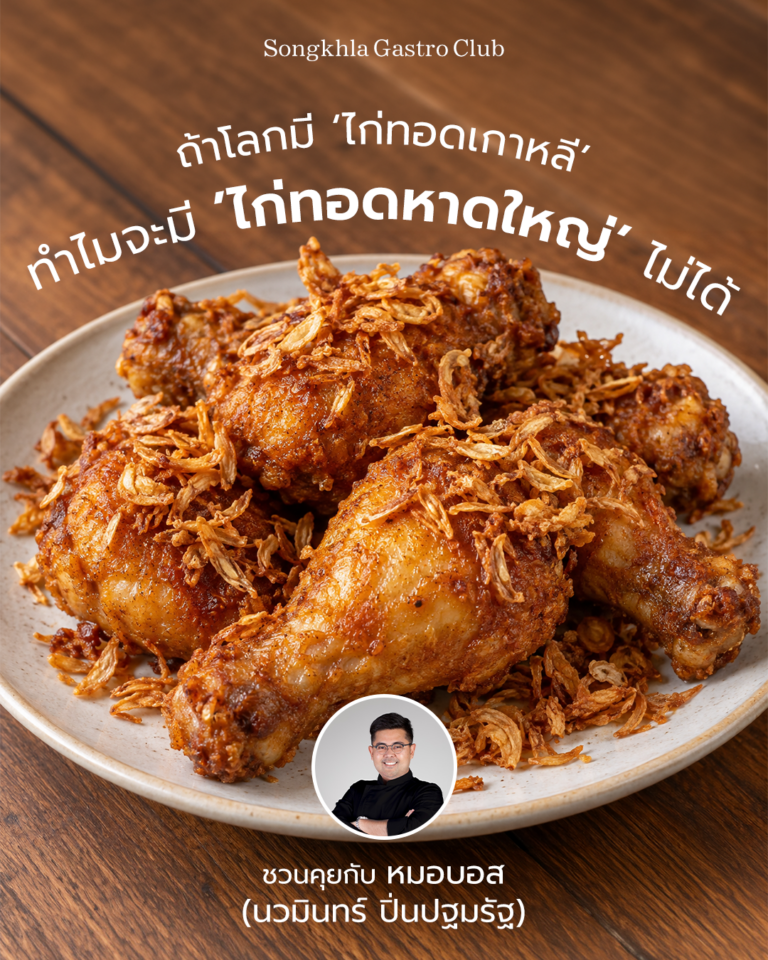
Hat Yai fried chicken, take the stage!
Dr. Boss’s answer is Hat Yai fried chicken.
It is an answer that immediately makes sense. Fried chicken is familiar across many cultures, while the name “Hat Yai” clearly links the dish back to its place of origin.
To take Hat Yai fried chicken further, however, Dr. Boss believes it needs serious collective support. There should be room for it to develop in different forms, alongside efforts to document its recipes and the knowledge behind its distinctive flavor.
If we want more people to know it, we should first deepen our own understanding of what we have. What gives Hat Yai fried chicken its character? How does each recipe differ? And which elements can be developed further?
When the conversation turns to tools such as geographical indications, or GI, Dr. Boss encourages us to consider both their scope and their limitations, while continuing other efforts – especially building awareness that connects the name of the dish back to the city.
His hope is that wherever people first discover Hat Yai fried chicken, it will inspire them to visit and taste it in its place of origin at least once.
And if he is going to dream as big as possible, Dr. Boss wants the world to recognize Hat Yai fried chicken as the best fried chicken in the world.
That ambition will require a great deal of collective effort. But it also raises a compelling question: when we already have a dish that is so easy for people to enjoy, how much further could we take it?
Would he be upset if someone reinvented it under the same name?
As the name of a dish travels, we may encounter versions of Hat Yai fried chicken that look and taste different from what we know. How should people from its place of origin respond?
Dr. Boss says he is not upset when people use the name Hat Yai fried chicken. Seen from another angle, they are also helping to introduce the dish to a wider audience.
He suggests separating questions of quality from questions of creativity. Experimentation and interpretation are part of a chef’s work. A version that differs from the familiar image creates an opportunity to ask what it is trying to express. Quality, meanwhile, remains a separate concern that deserves equal attention.
This perspective opens many possible paths for the future of Hat Yai fried chicken: passing on familiar recipes, recording knowledge for the next generation, and creating space for new dishes that we may not yet have imagined.
Who knows? The fried chicken we buy without a second thought may be the first dish that puts Songkhla on someone’s travel map. And when they arrive, an entire city of delicious food will be waiting to be discovered.


