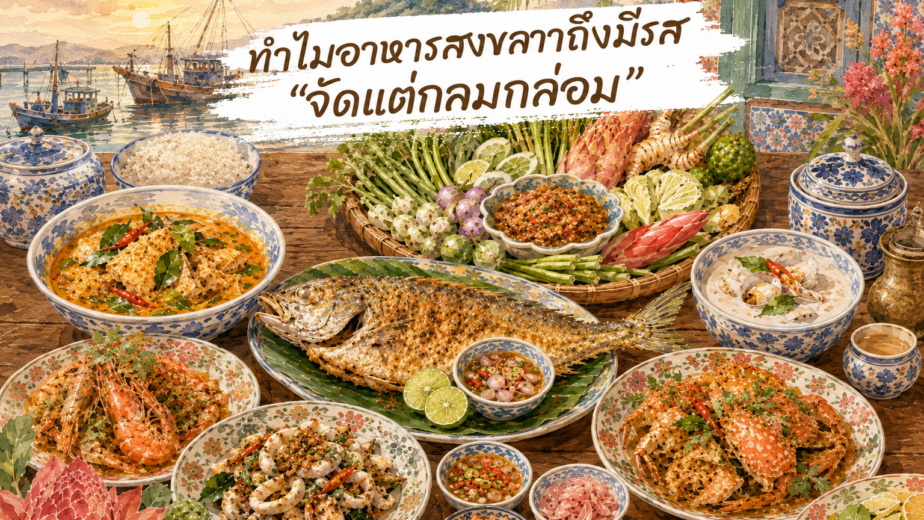
When people think of travelling in Songkhla, they may picture the old town, beaches, the lake, or the bold flavours of Southern Thai food. Venture a little farther, however, and every corner of the province reveals a local specialty with a story told through taste.
From orchards near Hat Yai to farming areas and fishing communities around Songkhla Lake, these specialties are shaped not only by local knowledge but also by the geography, soil, water, ecosystems, and ways of life that differ from place to place.
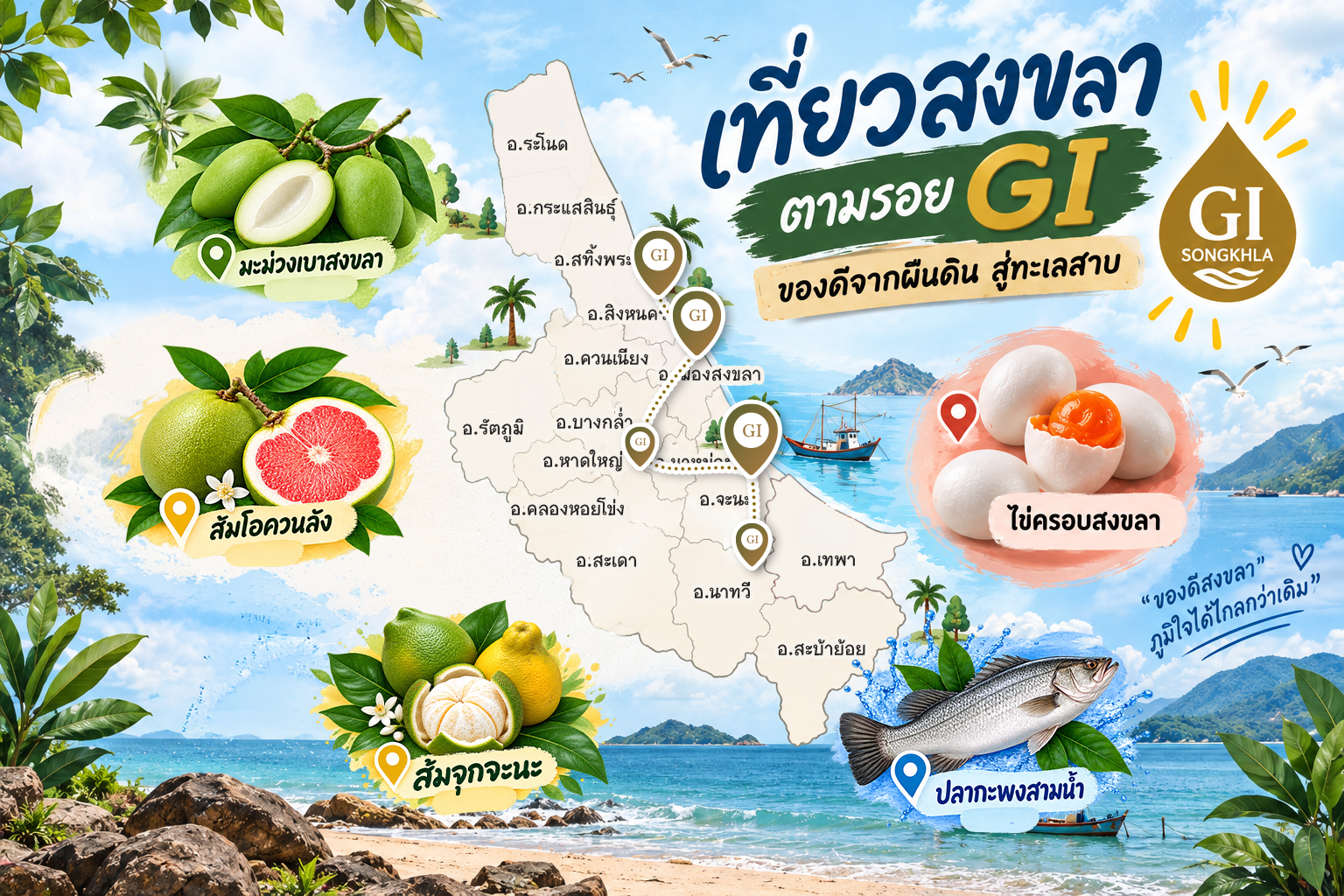
Join us on a journey to discover five GI specialties of Songkhla: Pomelo Hom Khuanlang, Som Jook Chana, Songkhla Mini Mango, Songkhla Lake Three-Water Sea Bass, and Songkhla Khai Khrop. Along the way, we will explore where each flavour comes from and what gives every specialty its distinctive character.
What GI Means and How It Helps Us Discover Local Places
GI stands for Geographical Indication. It identifies a product that originates in a specific place and whose quality, reputation, or characteristics are linked to that geographical origin.
Following a GI trail is therefore about more than finding where a local specialty is made. It also takes us back to the reasons it developed there and shows us why one place can produce flavours unlike those found elsewhere.
Ready? Open the map and let us begin the journey.
- Pomelo Hom Khuanlang | Khuan Lang
Our route begins near Hat Yai in Khuan Lang Subdistrict, Hat Yai District, the home of Pomelo Hom Khuanlang, one of Songkhla’s GI products. Its most distinctive feature is its exceptionally fragrant rind. The flesh ranges from deep pink to red and tastes sweet and tart without bitterness. It is soft and juicy, while the individual juice sacs remain crisp, creating a character unlike pomelos grown elsewhere. Khuan Lang has a long association with pomelo cultivation, and the place name has become part of the product’s GI-certified name.
GI FACT
Pomelo Hom Khuanlang
Key features: Fragrant rind, deep pink to red flesh, a sweet-tart flavour, and no bitterness
GI area: Khuan Lang Subdistrict, Hat Yai District, Songkhla Province
GI Registration No. 60100092
- Som Jook Chana | Chana
Continue to Chana District in search of a local fruit with an instantly recognisable appearance: Som Jook Chana.
The Thai name som jook refers to the raised neck at the stem end of the fruit, which resembles a small topknot. Both thick-skinned and thin-skinned varieties are grown. When ripe, the skin ranges from yellow and yellowish green to orange-green. It peels easily and carries a fragrance released by oil glands beneath the rind. The flesh is soft and juicy, with a sweet-tart flavour. Because the designated production area lies within Chana District, the place name is more than a label; it is an essential part of the fruit’s identity.
🔍GI FACT
Som Jook Chana
Key features: Distinctive raised neck, fragrant rind, soft and juicy flesh, and a sweet-tart flavour
GI area: Chana District, Songkhla Province
GI Registration No. 64100161
- Songkhla Mini Mango | Sathing Phra Peninsula
From sweet and tart fruit, we turn to the sharp sourness familiar to Songkhla residents: the Songkhla Mini Mango.
The mini mango is small, with thin pale-green skin and firm, crisp white flesh. Its strong aroma and pronounced sourness make it suitable for many uses: eaten fresh, tossed in a spicy salad, candied, pickled, or paired with the assertive flavours of Southern Thai food.
Interestingly, the GI cultivation area does not cover the entire province. It is limited to the Sathing Phra Peninsula, including Singhanakhon, Sathing Phra, Krasae Sin, and Ranot districts. Processing, however, may take place in any district of Songkhla Province.
🔍GI FACT
Songkhla Mini Mango
Key features: Small fruit, thin skin, firm and crisp flesh, a strong aroma, and a distinctly sour flavour
GI cultivation area: Singhanakhon, Sathing Phra, Krasae Sin, and Ranot districts
GI Registration No. 65100190
- Songkhla Lake Three-Water Sea Bass | Songkhla Lake
Leaving the land behind, the route continues to the heart of Songkhla: Songkhla Lake.
What makes the lake special is an ecosystem where fresh, brackish, and salt water meet, giving rise to the familiar description “the three-water lake.” This ecological diversity supports abundant aquatic life and sustains the fishing communities around the lake.
One specialty created by this environment is Songkhla Lake Three-Water Sea Bass. The Asian sea bass raised within the designated GI area has soft, white flesh and distinctive qualities linked to the lake environment and local farming practices.
The GI specification extends beyond fresh fish. It also covers registered products such as fresh and frozen sea bass, salted fish, and crispy fried fish-skin products.
🔍GI FACT
Songkhla Lake Three-Water Sea Bass
Key features: Asian sea bass from the lake’s three-water ecosystem, with soft white flesh
GI Registration No. 65100184
- Songkhla Khai Khrop | Sathing Phra Peninsula
The journey ends with a local food whose story is closely tied to the fishing way of life: Songkhla Khai Khrop, or preserved duck egg yolks.
In the past, fishers made nets and fishing gear from raw cotton thread. They used egg whites to treat the thread and make it more durable. This left them with large quantities of yolks, which they learned to preserve. That practical knowledge gave rise to khai khrop.
Songkhla Khai Khrop is made by placing two duck egg yolks in a single eggshell, then seasoning and cooking them. The finished yolks are glossy and reddish orange, with a rich flavour and gentle saltiness. Today, they are prepared in three textures: runny “lava,” soft-set, and traditional firm yolk. Their distinctive character is also linked to the Sathing Phra Peninsula, where aquatic animals from the lake supplement the diet of laying ducks. This helps produce large, vividly coloured, rich yolks that define the area’s khai khrop.
🔍GI FACT
Songkhla Khai Khrop
Key features: Reddish-orange duck egg yolks with a rich, mildly salty flavour, rooted in the knowledge of local fishing communities
GI area: Singhanakhon, Sathing Phra, Krasae Sin, and Ranot districts
GI Registration No. 66100198
Begin with Pomelo Hom Khuanlang near Hat Yai, head south to find Som Jook Chana, then return north towards Songkhla town and the lake. From there, continue up the Sathing Phra Peninsula in search of Songkhla Mini Mango, Songkhla Lake Three-Water Sea Bass, and Songkhla Khai Khrop.
Each stop offers more than something delicious to taste. Behind every specialty are the geography, ecosystems, people, and knowledge that created it and gave it a character of its own. A GI can therefore serve as a pin on the map, helping us read Songkhla’s story from another perspective.
On your next visit to Songkhla, add the GI trail to your itinerary and discover how the province’s flavours change from one area to another. Sometimes, getting to know a place begins simply by asking where the food in front of us came from and what story lies behind it.
Sources
“Pomelo Hom Khuanlang”
Source: Department of Intellectual Property, Ministry of Commerce — GI Registration No. 60100092
“Neck Orange Chana or Som Jook Chana”
Source: Department of Intellectual Property, Ministry of Commerce — GI Registration No. 64100161
“Songkhla Mini Mango or Ma-Muang Baw Songkhla”
Source: Department of Intellectual Property, Ministry of Commerce — Notice of Application for Geographical Indication Registration No. 196 and GI Registration No. 65100190
“Songkhla Lake Three-Water Sea Bass”
Source: Department of Intellectual Property, Ministry of Commerce — GI Registration No. 65100184
“Songkhla Khai Khrop”
Source: Department of Intellectual Property, Ministry of Commerce — GI Registration No. 66100198 and Thai Geographical Indication Journal, Issue 5