If there is one place in Thailand where geography can be experienced through food, Songkhla is undoubtedly among the best examples.
Located in Southern Thailand, Songkhla is far more than its beaches, historic old town, or stunning sunsets over the lake. It is a place where nature, local livelihoods, and culinary traditions have intertwined for centuries to create a distinctive gastronomic identity found nowhere else in the country.
From the unique ecosystem of Songkhla Lake, which connects to the Gulf of Thailand and creates the famous “Three-Water” environment, to the fertile Sathing Phra Peninsula shaped by sea breezes and rich soil, every corner of Songkhla produces ingredients with their own stories, heritage, and sense of place.
This is why several local products have been recognized as Geographical Indications (GI)—a certification that guarantees a product’s quality, reputation, and unique characteristics are directly linked to its place of origin.
In simple terms, even if the same production methods are used elsewhere, the taste can never be exactly the same.
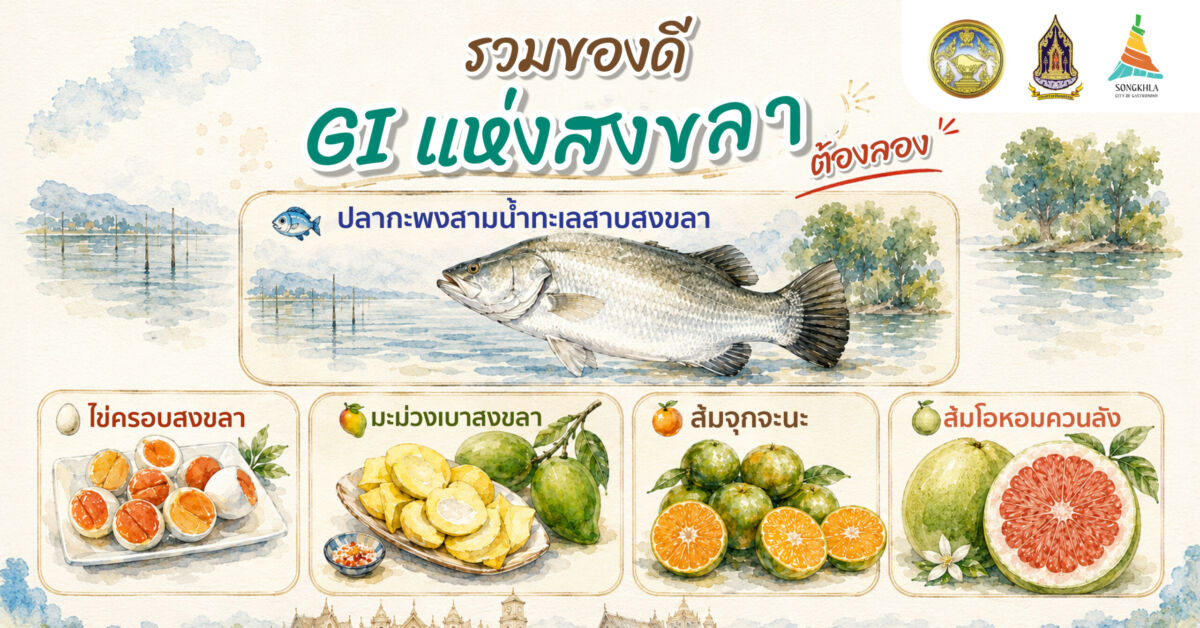
If you’re planning a visit to the City of Two Seas, these are four GI foods you should not leave without trying. Each bite offers more than flavor—it tells the story of people, nature, and living traditions.
1. Songkhla Three-Water Seabass: A Flavor Shaped by a Unique Ecosystem
When people talk about ingredients that best represent Songkhla, the answer is often Three-Water Seabass.
Its uniqueness does not come solely from being a premium fish, but from where it is raised. The fish are cultivated in the lower section of Songkhla Lake, where freshwater, brackish water, and seawater continuously meet throughout the year, creating the province’s distinctive “Three-Water” ecosystem.
Seasonal changes in salinity influence the fish’s growth, resulting in firm, white flesh with a naturally sweet flavor and minimal muddy taste. These characteristics have made Three-Water Seabass one of the most prized ingredients in Songkhla’s culinary scene.
Behind its quality lies generations of local aquaculture knowledge. To qualify as GI-certified Songkhla seabass, the fish must be raised in floating cages for at least one year and weigh no less than two kilograms.
Its versatility makes it suitable for a wide range of dishes, including:
- Deep-fried seabass with fish sauce
- Southern-style sour fish soup
- Steamed seabass with soy sauce
- Spicy seabass salad
- Contemporary fine dining creations
No matter how it is prepared, every dish carries the unmistakable taste of Songkhla Lake.
2. Songkhla Bao Mango: The Small Fruit with a Big Personality
In Southern Thailand’s tropical climate, few things are as refreshing as a crisp Bao mango dipped in chili salt.
Although small in size, Songkhla Bao Mango has become one of the province’s most celebrated GI products, particularly from the Sathing Phra Peninsula, where the finest varieties are cultivated.
The fruit is known for its thin skin, crunchy texture, firm flesh, and vibrant sourness. Its delicate fragrance and refreshing taste have become a lasting memory for many visitors to Songkhla.
The secret behind its distinctive flavor lies in the combination of coastal winds, local soil conditions, and the unique geography of Sathing Phra.
Originally grown as a household fruit for personal consumption, Bao mango gradually became one of Songkhla’s signature souvenirs due to its exceptional taste.
Today, it is transformed into a variety of products, including:
- Pickled Bao mango
- Preserved Bao mango
- Bao mango juice
- Bao mango ice cream
- Bao mango chili paste
Yet for many locals, the best way to enjoy it remains the simplest—freshly sliced and served with chili salt.
3. Songkhla Khai Khrob: A Lakeside Culinary Heritage
Among Songkhla’s GI products, Khai Khrob may be the ingredient that tells the most compelling story of local life.
This traditional delicacy originated in fishing communities around Songkhla Lake, particularly on the Sathing Phra Peninsula.
Historically, fishermen used duck egg whites to strengthen and preserve fishing nets, leaving a surplus of yolks. To avoid waste, local communities developed a preservation technique by placing two salted yolks back into an eggshell and steaming them.
The result is Khai Khrob—a delicacy with a rich orange color, silky texture, and perfectly balanced savory flavor.
It can be enjoyed simply with hot rice or incorporated into modern culinary creations.
Today, Khai Khrob has evolved beyond a traditional food item and become a symbol of Songkhla’s culinary soft power. Local chefs are increasingly using it in contemporary dishes such as:
- Rice topped with Khai Khrob
- Khai Khrob ramen
- Tom Yum Khai Khrob
- Khai Khrob pasta
- Seafood rice with Khai Khrob
From humble fishing villages to modern restaurant kitchens, Khai Khrob continues to bridge tradition and innovation.
4. Chana’s Som Chuk: A Heritage Citrus from the Coast
Another GI treasure that remains relatively unknown outside Southern Thailand is Som Chuk Chana, an heirloom citrus fruit native to Chana District.
Its name comes from the distinctive nipple-like protrusion at the end of the fruit, a unique feature that makes it instantly recognizable.
However, its true value lies in its flavor and aroma.
The fruit has a thin peel, juicy flesh, a balanced sweet-and-tangy taste, and a refreshing fragrance that distinguishes it from other citrus varieties.
Som Chuk thrives in Chana’s coastal environment, where sea breezes and mineral-rich soils contribute to its unique characteristics.
Although cultivation has declined in recent years, making the fruit increasingly rare, Som Chuk remains an important agricultural heritage crop and a symbol of Songkhla’s biodiversity.
More Than Delicious Food: Stories from the City of Two Seas
What makes Songkhla’s GI products special is not only their flavor, but also their connection to place.
- Three-Water Seabass reflects the wisdom of lakeside communities.
- Bao Mango represents the unique landscape of the Sathing Phra Peninsula.
- Khai Khrob tells the story of traditional fishing livelihoods.
- Som Chuk Chana showcases the richness of coastal agriculture.
Together, these foods reveal how geography, culture, and history are deeply intertwined in Songkhla.
Food here is not merely something to eat—it is living heritage and a vital part of the province’s vision as a future Creative City of Gastronomy.
Conclusion: To Understand Songkhla, Start by Tasting It
Some cities tell their stories through architecture. Others do so through museums.
Songkhla tells its story through flavor.
Perhaps the best way to understand this City of Two Seas is not by reading history books alone, but by sitting down to enjoy a local meal and allowing each bite to reveal the people, landscapes, and traditions behind it.
Because in Songkhla, every flavor comes with a story.