When people think of Songkhla, they often picture the sea, the historic old town, or the tranquil atmosphere of the lake at sunset. Yet beyond these iconic images lies one of Thailand’s most remarkable examples of how geography and food are deeply connected.
The cuisine of Songkhla did not emerge in isolation. It has evolved through generations of interaction between people, the environment, and the vast Songkhla Lake Basin. The ingredients found here, the cooking methods practiced by local communities, and the region’s culinary traditions all reflect a unique relationship between nature and culture.
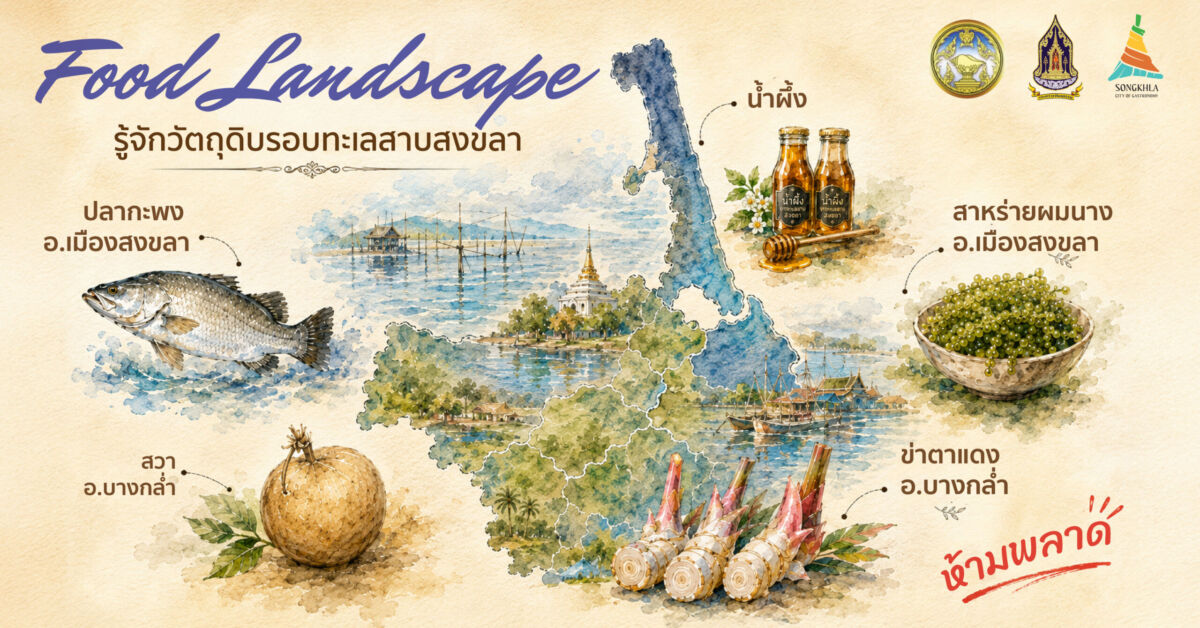
In the world of gastronomy, this relationship is often described as a Food Landscape—a concept that views food not merely as something served on a plate, but as the result of geography, ecology, history, culture, and local knowledge. By this definition, the area surrounding Songkhla Lake represents one of the most distinctive Food Landscapes in Southeast Asia.
Songkhla Lake: More Than a Wetland, a Living Food System
Songkhla Lake is Thailand’s only lagoon lake connected directly to the sea. It receives freshwater from rivers and canals in the upper basin while also welcoming seawater from the Gulf of Thailand. This interaction creates a unique three-water ecosystem, consisting of freshwater, brackish water, and saltwater.
Seasonal changes in salinity contribute to extraordinary biodiversity. Fish, shrimp, aquatic plants, agricultural crops, and native species all thrive under different environmental conditions throughout the basin. For centuries, this ecosystem has provided food and livelihoods for local communities.
The lake basin is therefore much more than a fishing area. It encompasses fruit orchards, rice fields, aquaculture farms, and agricultural communities that together form a large and interconnected food system. As a result, many of Songkhla’s signature ingredients are closely tied to specific geographical locations within the landscape.
Three-Water Sea Bass: A Taste Shaped by the Lake
One of the clearest examples of Songkhla’s Food Landscape is the famous Three-Water Sea Bass.
Raised in floating cages in the lower part of Songkhla Lake, these fish are influenced by the continuous circulation of freshwater, brackish water, and seawater. This unique environment gives the sea bass a firm texture, natural sweetness, and a clean flavor with minimal muddy odor.
The changing conditions of the lake require fish farmers to possess deep knowledge of nature, including water levels, seasonal patterns, currents, and weather conditions. As a result, Three-Water Sea Bass is not simply a product of aquaculture techniques; it is also the outcome of generations of local wisdom developed through living alongside the lake.
Today, this premium ingredient appears in a wide variety of dishes, from traditional southern recipes to contemporary gastronomy, where chefs reinterpret local ingredients through modern culinary techniques.
Koh Yo: An Island Shaped by Water and Food
At the heart of Songkhla Lake lies Koh Yo, a small island community where life has long revolved around the water.
Beyond its scenic beauty, Koh Yo plays an important role in the culinary culture of the lake basin. Local ingredients such as sea bass, silver-scaled fish, local freshwater species, and Lady Hair Seaweed (Phomanang Seaweed) all reflect the island’s unique ecosystem.
Among these ingredients, Lady Hair Seaweed is particularly noteworthy. Thriving in the lake’s brackish waters, it has been part of local cuisine for generations. It is commonly used in salads, curries, and traditional side dishes served alongside chili pastes.
While such ingredients may seem ordinary to local residents, they are highly significant from a gastronomic perspective because they represent food identities that are inseparable from their natural environment.
Sathing Phra Peninsula: A Land of Rice, Fruit, and Agricultural Wisdom
While the lake is known for fisheries and aquatic resources, the Sathing Phra Peninsula serves as one of the most important agricultural areas within the Songkhla Lake Basin.
Stretching between the lake and the sea, this narrow peninsula benefits from sea breezes, fertile soils, and favorable climatic conditions. These factors make it ideal for cultivating a variety of crops, including the renowned Sangyod Rice.
This indigenous reddish-brown rice is celebrated for its distinctive aroma, nutritional value, and texture. It has become one of Southern Thailand’s most iconic agricultural products and a symbol of local food heritage.
The region is also home to seasonal fruits such as Mamuang Bao (Songkhla Hog Plum Mango), Champada, and Thai Chebulic Myrobalan, all of which contribute to the diversity of Songkhla’s food culture and reflect the agricultural traditions of the lake basin communities.
Food Landscape: A Relationship Between People and Nature
What makes Songkhla’s Food Landscape truly remarkable is not simply the abundance of ingredients or the variety of dishes. Its significance lies in the relationships that connect:
- People and the lake
- Seasons and food
- Ecosystems and livelihoods
- Geography and flavor
For communities around Songkhla Lake, food is more than nourishment. It is part of daily life, cultural identity, and collective memory.
Traditional preservation methods, ingredient selection, seasonal eating habits, and local festivals all demonstrate a deep understanding of the natural environment. These practices embody the principles of Sustainable Gastronomy, a concept increasingly embraced by cities around the world.
Songkhla and the Future of Gastronomy
Across the globe, cities are beginning to recognize local food not only as an economic asset but also as a valuable cultural resource. Songkhla is following the same path.
From the ingredients found throughout the lake basin to the knowledge preserved within local communities, the province is creating a new dialogue between food, geography, culture, and sustainability.
Songkhla’s Food Landscape is therefore more than a collection of flavors. It is a living heritage that continues to shape the identity of the region and serves as a foundation for the city’s future development as a leading gastronomy destination.
Conclusion
Sometimes, understanding a place begins with understanding what its people eat.
In Songkhla, that journey leads far beyond the dining table. It reveals a remarkable three-water ecosystem, communities shaped by the lake, generations of local wisdom, and a long-standing relationship between people and nature.
This is the essence of Songkhla’s Food Landscape—a place where geography is not confined to maps, but can be tasted in every meal and experienced through every ingredient.